Articles
Warehouse identification and floor marking system
Overview:
Polyester labels are the popular, cost-effective choice for most warehouse racking applications. But put them on a wash-down line, out in the yard, on heavy impact stillages, and they fail.
They peel off. They tear away. They disappear.
They might as well never have existed, for all the use they are to busy workers looking for the right asset, equipment or location.
That leaves you with a choice. Keep replacing labels that can’t survive their environment, or fit metal barcodes and metal asset tags once and let them do the job for years. This guide covers when metal is worth the cost, how the materials compare, and how to choose the right tags for your facility.

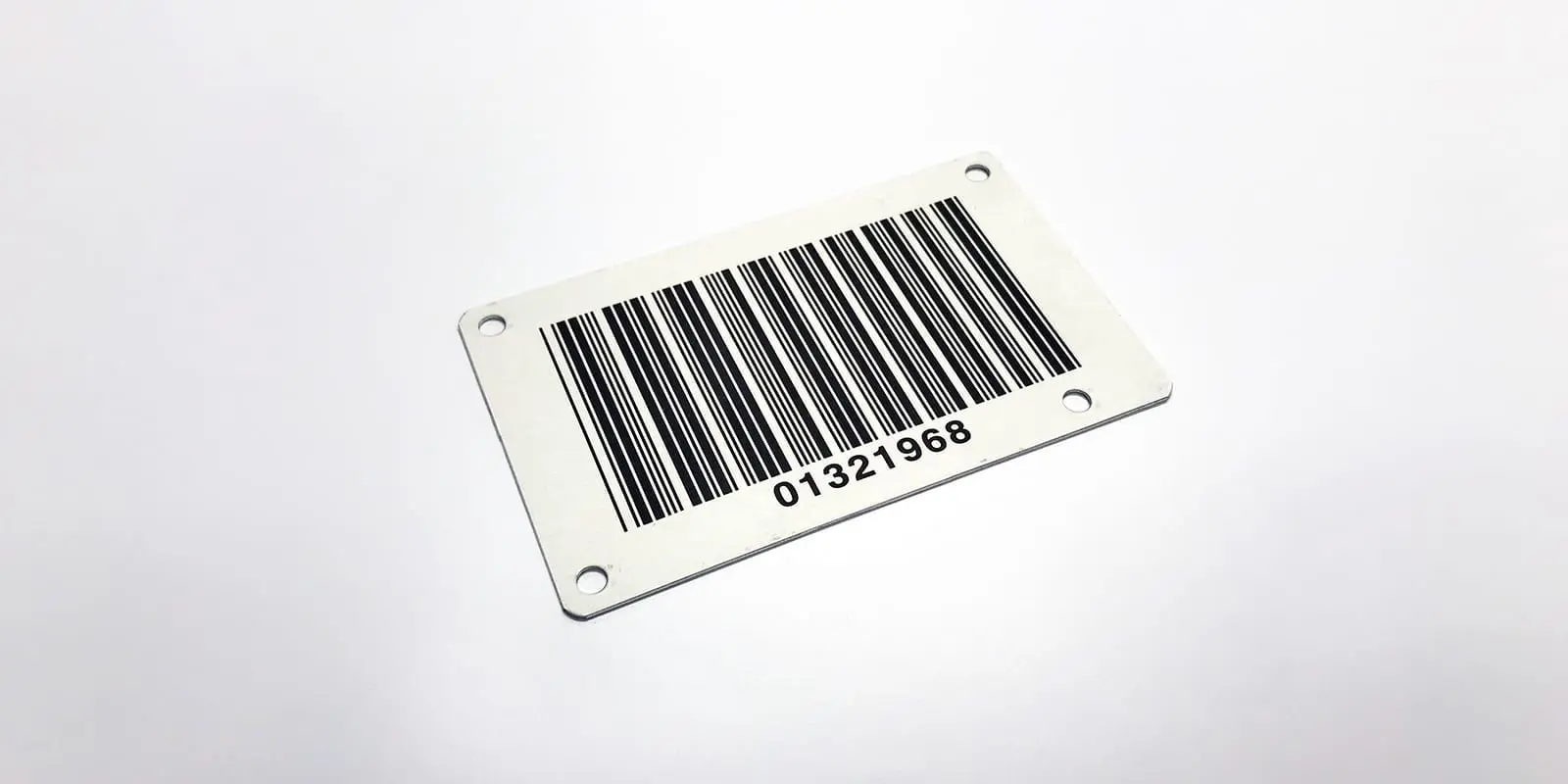
Metal asset tags and metal barcode labels are durable metal plates or labels that carry a barcode and human-readable data, fixed permanently to equipment or locations so each asset or position can be scanned and tracked. An asset tag is fixed to the thing you track, such as a machine, tool or container, while a location label is fixed to racking or a floor position.
Metal barcode tags and metal labels are the visible part of an asset tracking system. On racking, shelving and floors, they identify each storage position. On equipment, they give every asset a permanent ID. Either way, they’re the first thing your operators scan when they need to confirm they’re at the right location or loading the right stillage.
The tags can carry linear, 2D or stacked barcode formats, including QR codes, with alpha, numeric or alphanumeric content alongside.
An asset tag tells your people what they need to know, so they can:
And a metal asset tag makes sure your labels stay where they should be, instead of ending up scuffed and stuck to half a dozen forklift tires.

When polyester and plastic labels can’t stand the heat or the friction.
If your asset tracking labels sit indoors, in an ambient warehouse, where they won’t face heat, abrasion, forklift traffic, or solvents, there’s no reason to look past more affordable warehouse barcode labels or warehouse rack labels.
But if your team is regularly replacing damaged labels, and every relabel means downtime or lost assets, the up-front investment in durable asset tags made from metal gives you a much longer service life and return on outlay.
Choose metal:
Where durability matters more than up-front cost, choose metal.

Not all metal equipment labels are interchangeable. Sometimes an aluminum barcode label is the right choice compared to a stainless steel asset tag. When you’re choosing a metal label you want to last for years or variable image labels that won’t wash away under a hose, you need to choose the right kind.
Here’s how the main options compare.
When in doubt, start with anodized aluminum. It’s the most widely used option in warehouses and distribution centers: lightweight, corrosion-resistant, and reliable from freezer temperatures through to ambient. That’s why the majority of metal barcode labels ASG supplies are aluminum.
For an aluminum label, a photographic barcode and text sit beneath an anodized surface, meaning it can’t be scratched away or lifted off by solvents. It’s a warehouse and manufacturing workhorse.
Stainless steel is the choice where aluminum isn’t strong enough: chemical exposure, high-pressure wash-down, prolonged moisture, or outdoor use. It’s heavier than aluminum and costs more, but it won’t corrode, discolor or degrade in conditions that would shorten the life of a standard label.
That’s why stainless steel asset tags are used extensively in food processing, pharmaceutical manufacturing and outdoor asset tracking.
ASG’s steel tags are a separate option, built for strength and to fight moisture. They’re .034” steel with rugged urethane coatings, printed black on white with colored characters. They’re fixed to a surface, but are not generally supplied with an adhesive backing.
| Material | What sets it apart | Typical environments | Mounting |
|---|---|---|---|
| Anodized aluminum | Photographic sub-surface image that can’t be scratched away or lifted by solvents; black on natural aluminum gray | Rack and floor locations, freezer to ambient | Adhesive backing, drilled holes, or both |
| Stainless steel | Won’t corrode, discolor or degrade; heavier and costs more than aluminum | Chemical exposure, high-pressure wash-down, moisture, outdoors; food processing and pharmaceutical | Adhesive backing or drilled holes |
| Urethane-coated steel | .034” steel with rugged urethane coatings; black on white with colored characters | Locations that need extra strength or moisture resistance | Fixed to the surface; not generally supplied with adhesive backing |
Work through these six steps and you’ll have the right tags in the right places:
What do your tags have to withstand? Think temperature ranges, chemicals they’ll be exposed to, whether they’re indoor or outdoor, floor, rack, or stillage. Not all metal equipment tags will be used in every location, so map out your environment first.
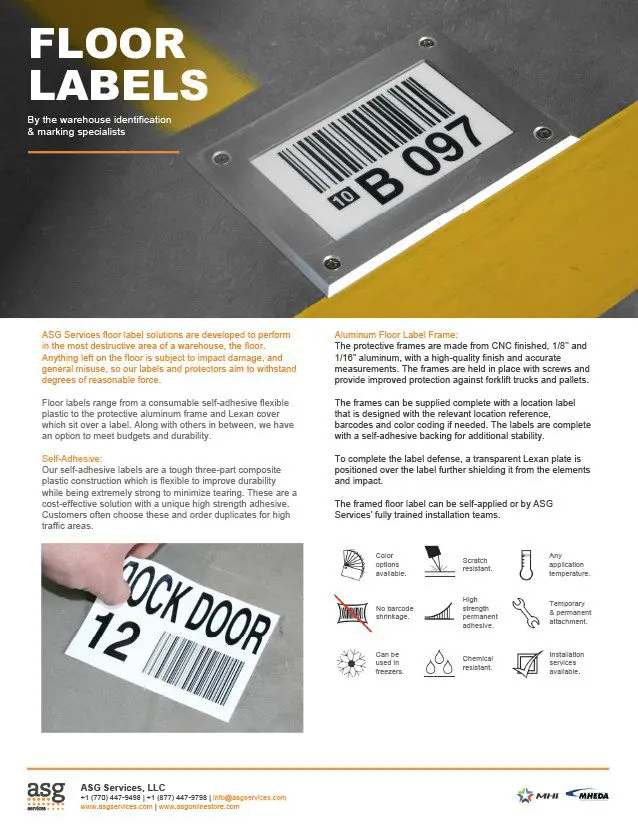
How will your tags be mounted? Equipment and rack tags can come with adhesive backing, drilled holes, or both. When used as floor tags, they are embedded in a recess with epoxy resin, or set in metal frame floor labels so they can be swapped out without redoing the floor.
Your people need to be able to read the data on your metal barcode tags. By checking the angle and distances they’re working with to scan codes and data, you can make sure to position each label in the right place.
Your warehouse label designs need the right symbology so your workers and visitors can see or scan the information easily. Linear, 2D and stacked symbologies are all available.
Choosing the right size comes down to scan distance and the space available. 6” x 4” is the most common size for floor tags, but most orders are custom, from small asset tags for equipment to large floor plates for extra visibility. Size each label for where it sits, rather than picking one size and hoping it fits all.
Think of this step as a storage location data service rather than simple labeling. Labels are printed with variable data straight from your location or asset data file, so plan your serial ranges, naming conventions and sequence early. ASG packages every label in reference-file sequence, which keeps installation or sorting in order. For naming help, see our guide to naming warehouse storage locations.
Labels and data only pay off as part of a wider system that helps you take control of your inventory.
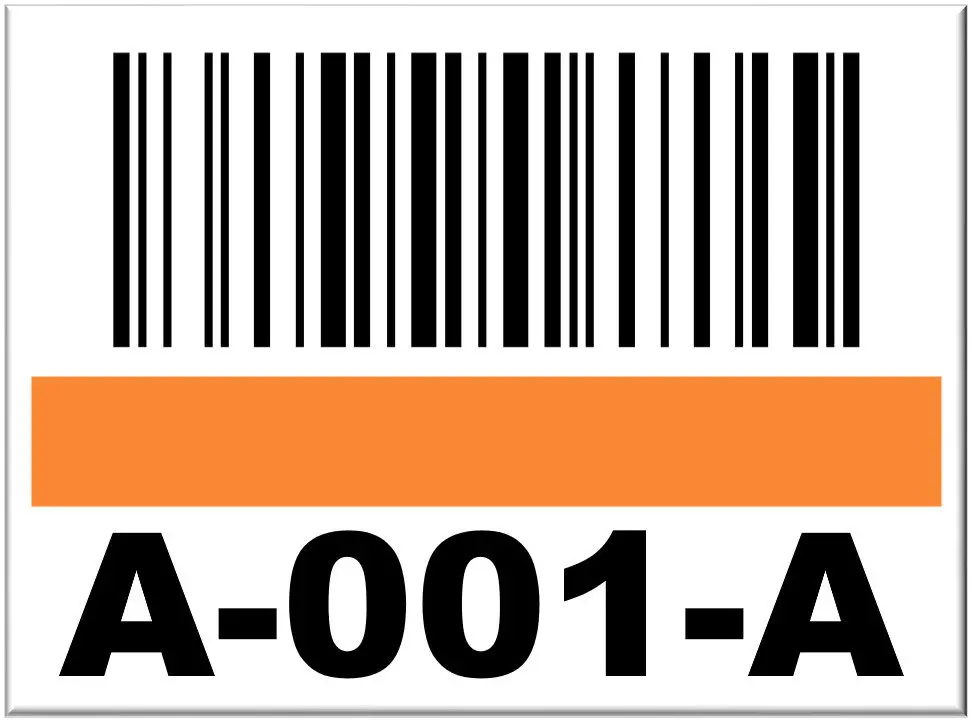
That means moving from labels to systems. Asset tracking labels, metal barcode asset tags and metal serial number tags are all numbered to tie each one to a specific asset or location, so choose your numbering scheme carefully. Serialized schemes are usually sequential (0001, 0002 and so on), while an alphanumeric range lets you group by type or place. For example, tooling could carry codes starting TL, or a location label could read A011 for aisle A, bay 11. The same thinking applies to the LPN and pallet labels on stock moving through those locations.
Whatever scheme you choose, match the tag data to your warehouse management system or asset register before you order. If you’re using 2D codes, our explainer on what a 2D barcode is covers the basics.
Serialized metal tags suit equipment that must stay traceable for years. Aerospace facilities use them on parts that must be traceable long after the batch paperwork is archived, automotive plants use them on components and tooling, and pharmaceutical sites rely on them to track equipment through autoclave cycles and chemical sterilization. For equipment asset tags, that durability is the point: plastic or handwritten tags won’t last the distance.
But remember to audit your long-term tags regularly. An asset label is only useful if it can be scanned from the right distance, and the right angle, on the first try.
With your tags chosen and your asset tracking program set, the last step is installation. It takes more than gluing a metal label to a rack, shelf, stillage or pallet.
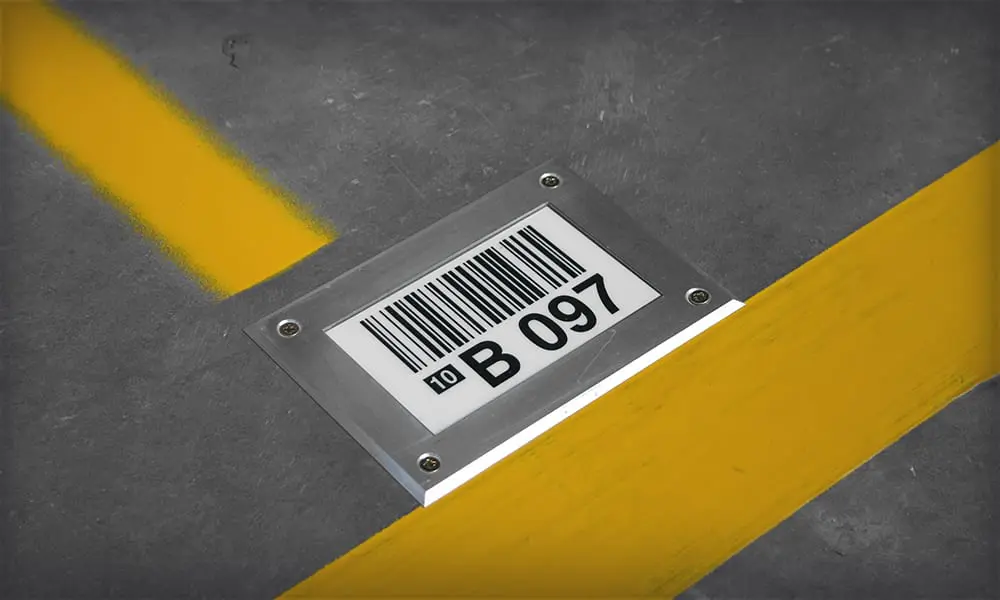
Fitting floor tags involves some of the most complex warehouse label installation. Because they’ll be added to high-traffic areas and need to last, a floor tag is usually embedded into a floor with epoxy resin. It’s hard-wearing and permanent when compared to adhesive floor labels, so the tag will remain readable for years to come if kept clean.
When you don’t want to redo your warehouse floor, metal frame floor labels are a low-impact option. Place them to the left or right of a location entrance to keep them away from traffic, and their aluminum frames and clear cover increase durability while staying easy to replace.
With metal labels for equipment, start with a clean, flat surface. Tags can be fixed with adhesive, drilled holes, or both, depending on the item and its environment. Just take care not to damage the equipment you’re tracking.
If you need help with installation and placement, ASG supplies and installs nationwide, with tags packaged in reference-file sequence to make installation quicker and simpler.

Help & Advice
An asset tag is a physical ID label placed on equipment, machinery or products within a storage facility or warehouse. They contain a barcode and/or alphanumeric codes and information that can be scanned or read at a distance.
Asset tags are used to track items and their locations. Asset tags can be used for inventory control, tracking stock as it enters or leaves a facility, and for equipment tracking by making it easier to monitor everything from forklifts to individual tools. Asset tags are also used for stock counting and auditing.
The sub-surface images on a metal barcode label mean they can last much longer than paper or polyester alternatives. They’re more resistant to extreme temperatures, abrasion and the effects of chemicals, oils, solvents and acids that would otherwise destroy a label.
Yes. Stainless steel is the usual choice for outdoor labels because it won’t corrode, discolor or degrade with moisture and weather exposure. Metal labels can also be cleaned without damaging the data they show.
Metal asset tags come in a range of standard and custom sizes. The most common floor tag size is 6” x 4”, but most orders are custom designed, from small asset tags for equipment to large floor plates.
Have other questions? Check out our FAQs.
Metal is worth it wherever labels face abrasion, chemicals, wash-down, temperature cycling or the outdoors. Match the material to the environment, plan your data, and the tags will do their job for years. Most orders are custom designed, so start with our metal barcode tags and labels to see the options.
Our Client List Keeps Growing!























































































Blog

Two-dimensional scanners were once far more expensive than linear readers, but recent developments and data needs have made the cost of 2D worth the investment.
Resources & Takeaways
Talk to the ASG team and we’ll help you choose the right sizes, materials and installation for your facility.
Find more…
Contact us and discover how we can help.

Call us
Speak to our friendly team. Mon-Fri from 8:30am to 5:30pm.

Email us
Have a question? Not sure where to turn? Our team are always available to help.

Learn more
Industry benchmarks are set on what we do and the quality of our products, find out why.

Download…
Information sheets, location data files, and white papers for you to take away.