Warehouse Signs, Labels and Line Striping | ASG Services
USA Made Manufactured outside Atlanta, GA · Installed nationwide

Custom warehouse signs.
Designed, built and installed.

Aisle, dock-door, hanging barcode and safety signage built in the USA for distribution centers under 10,000 sq ft to fulfillment facilities over 1.5 million sq ft. One supplier handles design, production and installation nationwide.

  • Long-range scannable barcodes readable from up to 65 ft
  • Custom sizes, colors and materials, no quantity minimum
  • Typical one to two week turnaround from order confirmation
  • Fully insured installation crews across all 50 states
Since 2001Atlanta-based manufacturing
NationwideInstallation coverage
1,856Signs in one CA launch
65 ftBarcode scan range

Get your custom quote.

Reply within one business day. No obligation.

Free

Your info stays with ASG. No spam, ever.

Trusted by the world's largest distribution operations

Amazon
Apple
Walmart
FedEx
UPS
Tesla
Coca-Cola
Pfizer
Bosch
IKEA
Kubota
Kimberly-Clark
Hilti
Henkel
Husqvarna
LG
In-house production
Designed and printed by ASG in Atlanta, GA
One to two week turnaround
From confirmed artwork to shipped product
Long-range barcodes
Scannable from up to 65 ft on retro-reflective material
No quantity minimum
Order 10 signs or 10,000. Same treatment
Designed, produced and installed throughout the US.

One supplier. Every warehouse sign.

Most sign shops produce graphics. ASG handles the data, the manufacturing and the install, so your launch schedule stays on track.

01. Built for logistics

Not a sign shop.

Variable data, sequencing and high-volume location identification are built into how our production line runs, so your signs print correctly the first time and arrive in the right order for install.

02. One team

Design, manufacture, install.

Our project managers coordinate artwork, production and on-site installation under one roof. Crews are trained in-house and insured for live DC and new-build environments alike.

03. Built to last

For real warehouse conditions.

Foam board, flute board, aluminum composite, steel, composite wood. We pick the material to suit your facility. High-definition digital print keeps logos, brand colors and barcodes crisp.

Custom or off-the-shelf. Every permutation we make.

Types of custom warehouse signs.

Click any product to start your quote, or jump straight to the online store if you know what you need.

Specify it right, place it right, pass inspection.

Warehouse safety signs: OSHA and ANSI compliance.

Warehouse safety signs in the US operate within a defined regulatory framework. Understanding it helps you specify the right sign, place it correctly, and pass inspections without rework.

Standards that govern warehouse safety signs

Two sets of requirements apply to most US distribution facilities:

Sets the baseline for accident prevention signs and tags. It defines required colors, signal words, and where specific sign types must be posted. Non-compliance carries fines of up to $16,131 per serious violation and up to $161,323 for willful or repeat violations.

Provides the detailed design specification: color values, font requirements, symbol usage, and header formats. Although technically voluntary, OSHA regulations reference ANSI Z535 directly, which makes it the practical compliance standard for any facility subject to federal inspection.

The two sets of requirements work together. OSHA tells you what to post and where. ANSI tells you how warehouse safety signs must look.

ASG-produced warehouse safety signs and 5S placards
5S and safety placards produced to OSHA 1910.145 and ANSI Z535.2.

Signal word classifications for warehouse safety signs

OSHA and ANSI Z535 define three hazard levels for warehouse safety signs. Each uses a fixed signal word, header color, and text color. Using the wrong combination is a compliance failure, even if the message itself is correct.

DANGER
Red header, white text

Reserved for immediate hazards where failure to act will result in death or serious injury.

ExamplesHigh-voltage areas, unguarded conveyor systems, chemical storage zones.
WARNING
Orange header, black text

Used where a potential hazard could result in death or serious injury if ignored.

ExamplesForklift crossing zones, dock leveler edges, overhead crane operating areas.
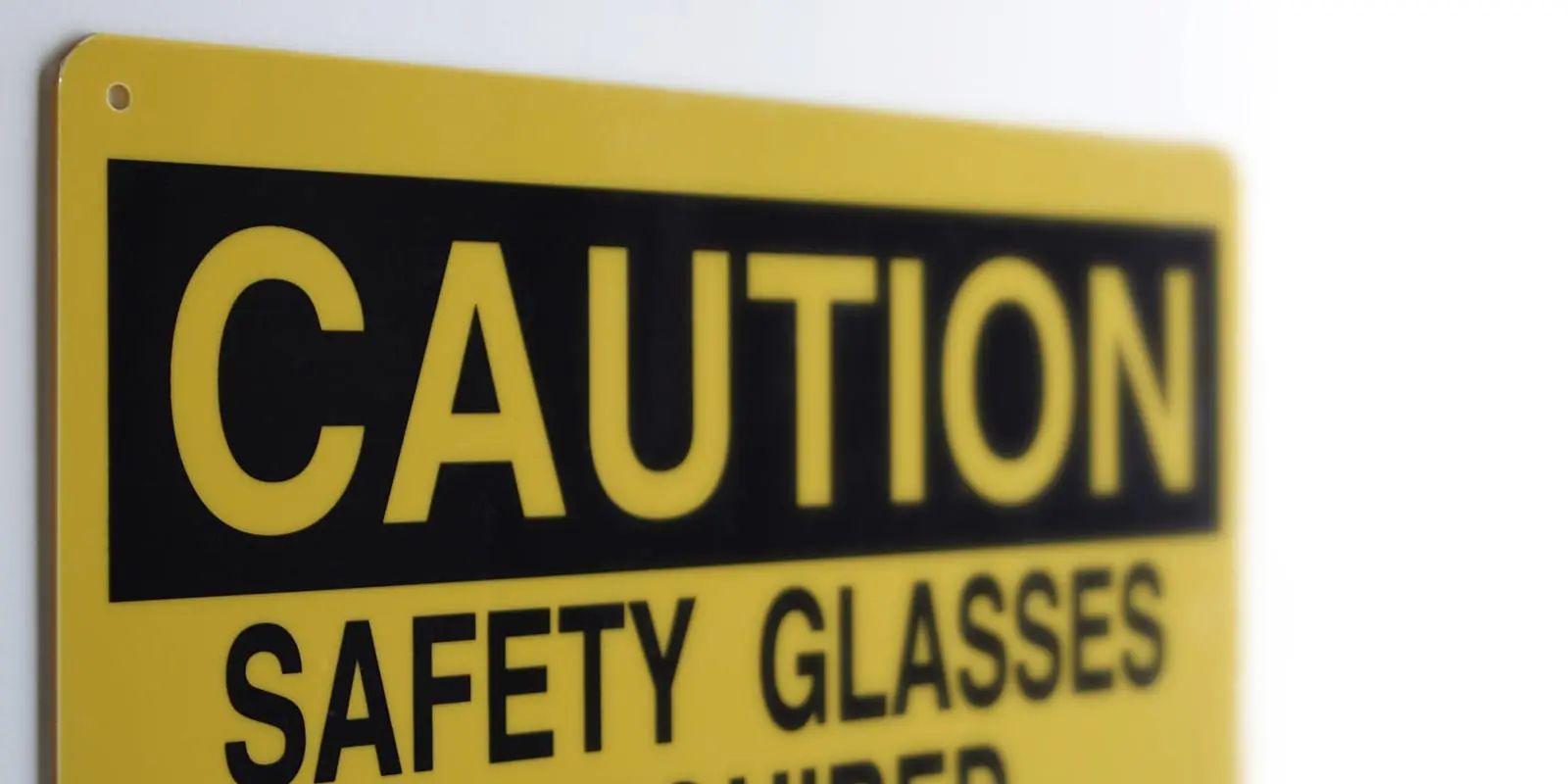
CAUTION
Yellow header, black text

Applied to lower-severity hazards that could cause minor to moderate injury.

ExamplesWet floor zones, low-clearance areas, slip-risk pedestrian routes.
NOTICE
Blue header, white text

NOTICE signs are not hazard classifications. They carry operational or procedural information with no injury risk attached.

ExamplesAuthorized personnel zones, loading protocols, PPE requirements.

OSHA standards specific to warehouse signs

Four OSHA standards are most relevant to distribution facility signage:

Walking-Working Surfaces

Requires clearly marked aisles and passageways.

Emergency Exit Routes

Exit route signage must be permanently posted, illuminated or self-luminous, and unobstructed.

Signs and Tags

The core warehouse signs standard covering color, wording, and placement requirements.

Powered Industrial Trucks

Mandates visible signage at forklift operating zones, pedestrian crossing points, and speed limit areas.

ASG Services produces 5S and safety placards, rack load signs, and custom compliance warehouse signs built to meet these standards. If you are unsure which classifications apply to specific areas of your facility, our project team can advise before production begins.

Traffic flow and aisle management.

Warehouse directional signs.

Warehouse directional signs do two jobs: they get people and vehicles to the right place, and they separate pedestrian and forklift traffic. In a busy distribution center, both are safety functions as much as operational ones.

01. Directional signage

Warehouse aisle signs

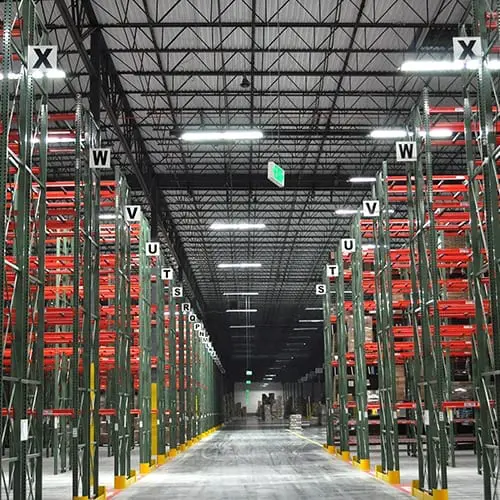
Aisle numbering is the primary location identifier in most warehouses. Warehouse aisle signs are typically hung from overhead steelwork at the aisle entrance, angled toward the approaching picker or driver for clean sightlines at distance. ASG produces hanging aisle signs in single-face, double-face, and multi-face configurations. Content can include aisle numbers, zone identifiers, commodity categories, or barcode locations for WMS integration.

Warehouse aisle signs
02. Directional signage

Forklift and pedestrian separation

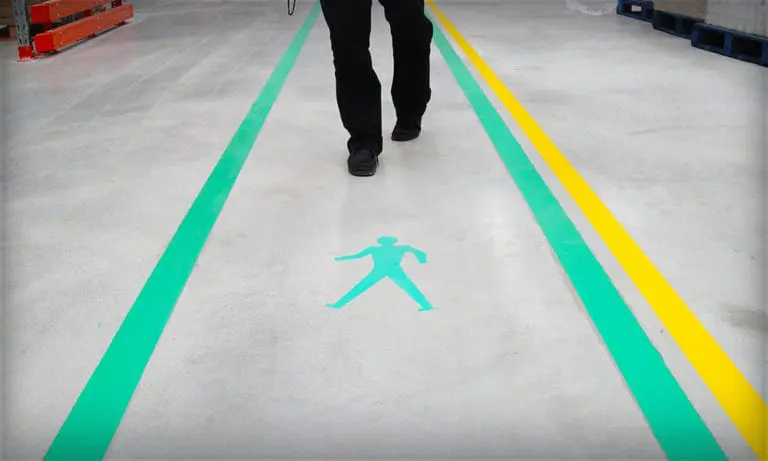
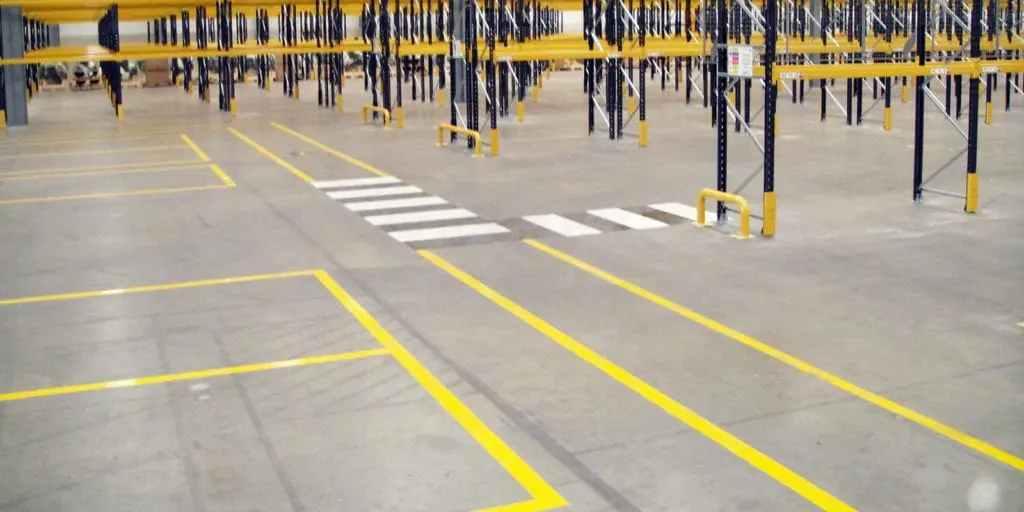
Where forklift routes and pedestrian walkways share space, warehouse directional signs must be unambiguous. Signs showing traffic direction, speed limits, and pedestrian priority zones are required under OSHA 1910.178 wherever powered industrial trucks operate. These typically combine with floor striping to create a complete traffic management system.

Forklift and pedestrian separation
03. Directional signage

Dock door signs

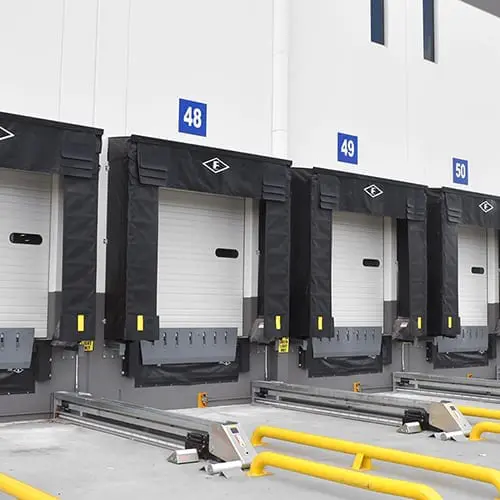
Dock door signs are a key category of warehouse directional signs. Dock numbering keeps inbound and outbound operations running to schedule. Internal dock door signs help warehouse teams identify doors from the floor. External signs allow drivers to locate the correct bay without entering the building. ASG produces dock door signs for both applications, with weather-resistant materials for external use.

Dock door signs
04. Directional signage

Barcode hanging signs for bulk locations

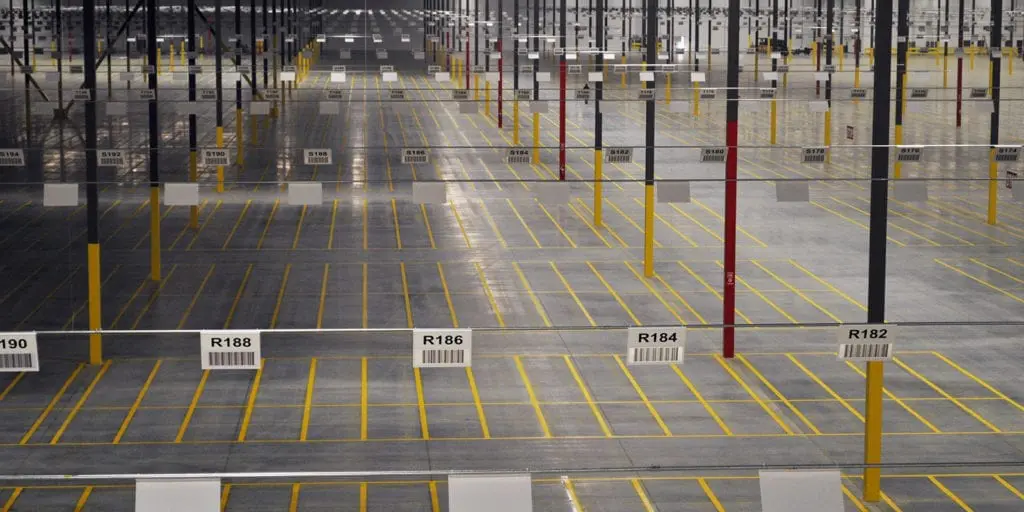
Block-stack and bulk storage areas without fixed racking use barcode hanging signs to assign scannable location identities to floor zones. These warehouse signs hang from ceiling steelwork and carry barcodes produced on retro-reflective material, readable at 50 to 65 feet with a compatible long-range scanner. Location data is variable per sign, supplied in a sequence that maps directly to your WMS location file.

Barcode hanging signs for bulk locations
Operational and procedural content.

Informational and operational warehouse signs.

Not every warehouse sign is a hazard warning or a location identifier. A significant category carries operational and procedural information that keeps the facility running correctly without referencing a specific safety risk.

OSHA defines NOTICE signs as the appropriate format for this content: blue header, white text, black body. Common applications for informational warehouse signs in distribution environments include:

  • "Authorized Personnel Only", "Employees Only", "Restricted Area" Area access restrictions.
  • "Hard Hat Required Beyond This Point", "Hi-Vis Vest Required in This Area" PPE requirements at zone entry points.
  • Equipment protocols Charging station procedures, battery handling instructions, MHE operating rules.
  • Custom shadow boards Shadow board headers, tool station identifiers, consumables zone markers.
  • Branded signs Company name, department, or operational zone identification on overhead or wall-mounted warehouse signs.

ASG produces all of these as custom-designed warehouse signs. Our sign design services team can produce standard OSHA-format NOTICE signs and custom-designed operational placards built to match facility branding. Both are available from a single order.

Custom shadow boards and operational placards
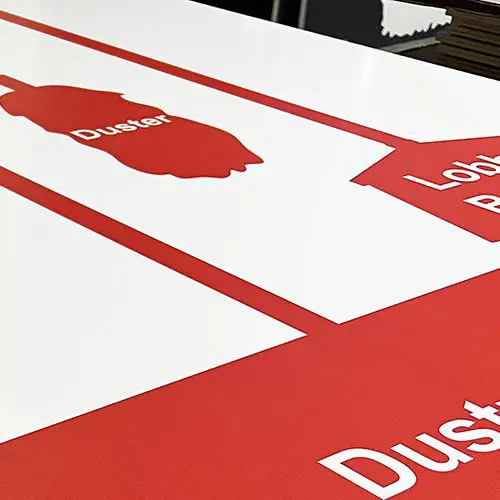
Custom shadow boards, tool station identifiers and branded operational placards.
Production materials and methods.

Choosing the right material for warehouse signs.

Material choice affects cost, durability, and how a warehouse sign performs over time. The right option depends on where the sign goes, how it is mounted, and what the environment requires.

01.

Aluminum composite (ACM)

The standard choice for hanging aisle signs and overhead identification. Rigid, lightweight, and dimensionally stable. Performs reliably in warehouse temperature ranges including cold storage environments.

02.

Foam board and flute board

Cost-effective for internal informational warehouse signs and short-run applications where impact resistance is not a requirement. Not suitable for high-traffic areas or environments with moisture exposure.

03.

MDO board (medium-density overlay)

A wood-composite panel with a resin-impregnated face, used where a heavier, more rigid substrate is needed. Works well for large-format wall-mounted warehouse signs.

04.

PVC board

Semi-rigid, moisture-resistant, and easy to cut to custom shapes. Used for operational signs in areas with humidity or light wash-down exposure.

05.

Steel

Used for rack load signs and applications where the warehouse sign must resist physical impact. Can be produced with a printed face or engraved content depending on the application.

06.

Semi-rigid composite

A flexible substrate that holds a formed angle. ASG forms these to a fixed angle during production so they maintain their position permanently, used for warehouse signs that need to point toward the viewer rather than hang flat.

-20°F

For environments with freezer or cold storage zones, material selection needs to account for temperature cycling. Not all adhesives and substrates perform consistently across the temperature range from ambient to -20°F. ASG's cold storage warehouse sign systems are specified for these conditions.

Predictable, project-managed, built around your schedule.

From request to installed signage, in four steps.

01.

Submit your spec.

Send a location list (we accept Excel), drawings, or just an idea. We quote based on what you have.

02.

Approve a sample.

We build a real sample so you can test it on your floor, on your scanners, in your lighting. No surprises.

03.

We manufacture.

Production runs in Atlanta with QC checks for content, sequencing and finish. One to two week typical turnaround.

04.

We install or ship.

Our trained crews install around your live operation, or we ship complete kits if you prefer to self-install.

Warehouse sign installations.

Warehouse sign placement and installation guidelines.

Correct placement determines whether a warehouse sign system works as intended. The most common installation errors come from hanging signs at the wrong height or failing to account for obstructions created by inventory.

01.

Height considerations for hanging warehouse signs

NFPA 13 requires that warehouse signs do not obstruct sprinkler spray patterns. Signs hung below sprinkler heads must maintain the minimum horizontal clearance specified by the sprinkler manufacturer, typically 18 inches from the sprinkler centerline. Signs hung above sprinkler heads have no clearance requirement.

Block-stack storage creates a secondary constraint. Warehouse signs must clear the maximum stack height at the face of the stack, not just at the floor. ASG’s project team calculates effective hang height before production begins, so sign sizes are correct for the intended viewing distance.

02.

Scan distance and barcode size for aisle signs

For hanging barcode signs, barcode width and scan distance are directly related: a wider barcode scans from a greater distance. If your RF scanners are rated to 50 feet, the barcode on your aisle signs needs to be sized to match that range at the intended hang height. Request a sample before committing to full production on any new facility.

03.

Installing warehouse signs in live operations

Most warehouse sign installations take place in operating facilities. ASG’s installation teams work in live warehouses as a standard practice. Project managers produce detailed work plans that define which aisles are closed at any given time, how product access is maintained, and how installation sequences around shift changes and peak picking windows.

04.

New build timelines for warehouse signs

For new builds, warehouse sign installation typically follows floor striping and racking installation. Hanging aisle signs require completed steelwork. Wall-mounted and dock door signs can go in earlier. Our warehouse signage installation team coordinates directly with general contractors and racking suppliers and schedules around their work.

Hanging warehouse signs installed in a live California distribution center
Hang height calculated before production, so sign sizes suit the viewing distance.
"
★★★★★

You delivered ahead of schedule.

This was something that I honestly did not think would turn into reality when I called you on Tuesday. But, I had an idea… You agreed to discuss further and we had a half hour discussion, you signed up and the rest is history. You and your team delivered 24 hours in advance of your commitment in Houston… amazing in my opinion.
Kyle · Dallas, TX · Consumer electronics retailerWarehouse hanging signs delivered direct to site
Trusted by household-name brands worldwide.

Real warehouses. Real numbers.

Barcode signs for a California DC.01. California
1,856signs

Barcode signs for a California DC.

1,856 hanging barcode location signs, installed a day ahead of schedule in a huge distribution center in California.

Warehouse labels and signs in Vegas.02. Las Vegas
356Klabels

Warehouse labels and signs in Vegas.

356,000 shelf labels, 67,500 polyester rack labels, hanging signs, mirrors and aisle signs across one massive facility.

Rack labels, signs and striping in Tampa.03. Tampa
12,000rack labels

Rack labels, signs and striping in Tampa.

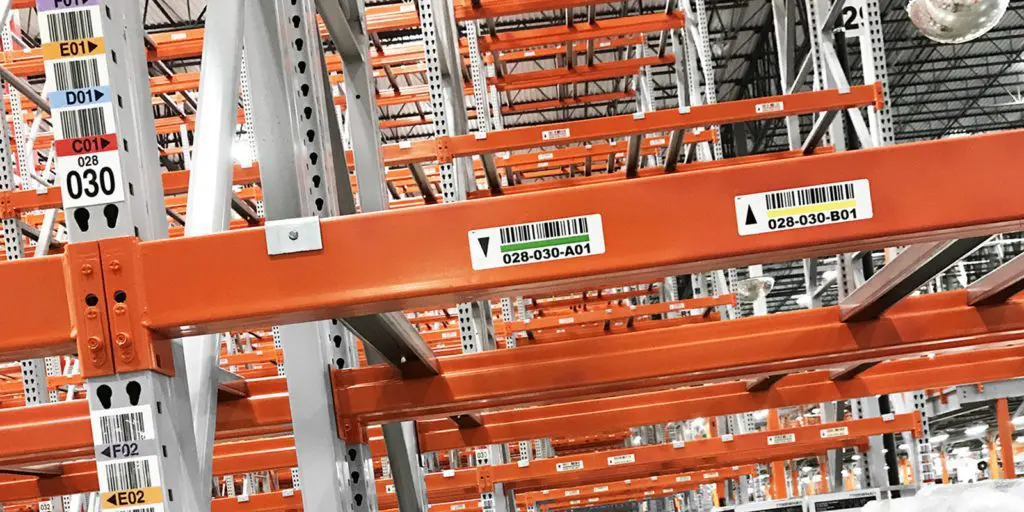
12,000 rack labels installed in 3 days, plus 1,100 retro-reflective barcode signs and 2,400 ft of floor striping for a world-renowned beverage company.

ASG Online Store.

Need it fast, or want to do it yourself?

Browse standard sizes and stock products on the ASG online store. Same quality, same materials, ready to ship.

Browse our online store
Help & advice.

Frequently asked questions.

How long will it take for me to get my signs?+

Lead times are variable, owing to quantity, complexity and production volumes at the time of order. We do typically aim for a one-to-two week turnaround from order confirmation, and we work hard to fit your launch window.

What sizes and colors do you supply?+

All products from ASG Services are custom made. We can supply any size, color and content required. Our online store lists stock sizes, for those looking to purchase basic items.

How far away can I stand and scan them?+

Warehouse barcode signs use long-range material to print the barcode on. The material allows the user to stand around 49 to 65 ft away and scan the barcode with ease, if their hardware is equipped with the relevant components.

Where do your installation services cover?+

Most of our installation projects are based in the US, but we travel throughout the world with customers who trust in our services. We also partner with similar suppliers around the world, so we can refer you to a closer company if needed.

What is your minimum order quantity?+

Order quantities are irrelevant at ASG. We treat all orders as a customized requirement. We do have a minimum order value in dollars, but this is nearly always irrelevant.

You did our facility in OH and we have another opening in PA, can we get the same signs?+

Yes. We operate an archive system, so your previous orders, including designs, location references and other documentation are available for retrieval. We can replicate your previous warehouse identification system at the new site.

What OSHA regulations apply to warehouse safety signs?+

Four OSHA standards govern warehouse safety signs in US distribution facilities. 29 CFR 1910.145 is the core standard for signs and tags, setting the required colors, signal words (DANGER, WARNING, CAUTION, NOTICE) and where each type must be posted. Non-compliance carries fines of up to $16,131 per serious violation.

Three further standards apply to most sites. 29 CFR 1910.22 requires clearly marked aisles and passageways. 29 CFR 1910.36 requires permanently posted, illuminated exit route signage. 29 CFR 1910.178 requires visible signs at every forklift operating zone, pedestrian crossing and speed limit area.

OSHA 1910.145 works alongside ANSI Z535, which specifies the design detail: exact color values, fonts and symbols. ANSI Z535 is voluntary, but because OSHA references it directly it is the practical standard for any facility subject to federal inspection.

ASG produces 5S and safety placards, rack load signs and custom compliance warehouse signs built to both standards. Our sign design team can advise on which classifications apply to specific areas of your facility before production begins.

warehouse-safety-signsOSHA-1910-145ANSI-Z535warehouse-compliance
What is the difference between DANGER, WARNING, and CAUTION warehouse signs?+

DANGER, WARNING and CAUTION are the three hazard classifications defined by OSHA 1910.145 and ANSI Z535, each with a fixed color code that cannot be interchanged. Using the wrong signal word is a compliance failure even when the message itself is correct.

DANGER signs use a red header with white text. They are reserved for immediately life-threatening conditions where failure to act will result in death or serious injury, such as unguarded conveyor systems, chemical storage zones and high-voltage areas.

WARNING signs use an orange header with black text. They apply where a potential hazard could result in death or serious injury if the sign is ignored, such as forklift crossing zones and overhead crane areas.

CAUTION signs use a yellow header with black text. They cover lower-severity hazards likely to cause minor to moderate injury, such as wet floor zones and low-clearance areas.

NOTICE signs (blue header, white text) are not a hazard classification. They carry procedural information with no injury risk, such as PPE requirements and access restrictions.

ASG produces all four formats as 5S and safety placards and custom compliance signage. Where signs mark forklift and pedestrian routes they often pair with warehouse floor striping to complete the traffic management system.

warehouse-safety-signsDANGER-WARNING-CAUTIONANSI-Z535signal-words

What material should I use for warehouse aisle signs?+

Aluminum composite (ACM) is the standard material for warehouse aisle signs. It is rigid, lightweight and dimensionally stable across the temperature ranges of most distribution facilities, including cold storage, and it holds printed color accurately over time. Most ASG hanging aisle signs use ACM.

The right choice depends on where the sign goes, how it is mounted and what the environment demands. Steel suits rack load signs and any application where the sign may take physical impact from equipment or pallets, and it can carry a printed or engraved face. PVC board works well for operational signs in areas with humidity or light wash-down exposure, since it is semi-rigid, moisture-resistant and easy to cut to non-standard shapes.

For cold storage and freezer zones, not all adhesives and substrates perform reliably across the full range from ambient to -20°F. ASG’s cold storage sign systems are specified for these conditions and tested against temperature cycling before delivery. If you are unsure which material fits a specific area, our sign design team can advise before production.

warehouse-signsaisle-signsACMsign-materialscold-storage
How high should hanging warehouse aisle signs be installed?+

There is no single correct height for hanging aisle signs. Four variables interact to set the right position for each warehouse: sprinkler clearance, block-stack height, scanner range and sign size.

Sprinkler clearance is the first constraint. NFPA 13 requires signs not to obstruct sprinkler spray patterns. A sign hung below a sprinkler head must keep at least 18 inches of horizontal clearance from the centerline; a sign hung above the heads has no clearance requirement.

Block-stack height sets a floor on sign position. Aisle signs must clear the maximum stack height at the face of the stack, not just at floor level, which in high-bay operations can push signs well above a standard hanging height.

Scanner range drives barcode sizing. A wider barcode reads at a greater distance, so sign height and barcode width must match the scanner specification. For RF scanners rated to 50 feet, the barcode needs to be sized for that range at the intended hang height.

ASG calculates effective hang height before production begins, so sign dimensions are correct for the viewing distance and scanner specification of each aisle. See our barcode hanging signs page for specification options, or talk to our signage installation team about a live-site survey.

aisle-signswarehouse-signssign-installationNFPA-13scan-distance
Do warehouse signs need to comply with ANSI Z535?+

ANSI Z535 is technically voluntary, but OSHA 1910.145 references it directly, which makes it the practical compliance standard for any warehouse sign in a US facility subject to federal inspection. A sign that does not meet ANSI Z535 design specifications can fail an OSHA inspection even when the message content is correct.

ANSI Z535 covers the design detail OSHA does not: exact color values, font specifications, symbol usage, header formats and the visual hierarchy of each signal word panel. This is where aftermarket or DIY signage usually falls down, with header colors that miss the required Pantone or RAL values or signal word typography that does not meet the standard. For warehouse applications the relevant edition is ANSI Z535.2, which covers environmental and facility signs; ANSI Z535.4 covers product safety labels.

ASG produces 5S and safety placards and compliance signage to ANSI Z535.2, with color values, signal word formatting and header geometry built into the production files. If you are replacing existing non-compliant signs, our sign design team can audit current signs and recommend the correct replacement specification before production begins.

warehouse-safety-signsANSI-Z535OSHA-compliancesign-specifications
Find more. Contact us and discover how we can help.

Ready to spec your warehouse signage?

Send us your location list or just an idea. We come back with a quote, lead time and material recommendation inside one business day.

Call (877) 447-9798
Call us